Contact

Showing posts with label Guestpost. Show all posts

Wednesday, April 20, 2016

Guestpost by Mercedes Rochelle (author of The Sons of Godwine)

I am happy to have Mercedes Rochelle stop by JustOneMoreChapter today with this special guest post.  She is currently touring the blog world with her newest book The Sons of Godwine.


Who Was Wulfnoth Godwineson? 
by Mercedes Rochelle

In this 950th anniversary year of the Battle of Hastings, most of us have heard the story about Harold Godwineson (or Godwinson), last of the Anglo-Saxon kings and the arrow in his eye. But how many know about his younger brother Wulfnoth? Born about 20 years after his famous sibling, Wulfnoth was whisked away as hostage for his father's good behavior when he was only about 12 years old. In all the confusion surrounding Godwine's return from exile in 1052, he was probably kidnapped by the Archbishop Robert of Jumièges, who fled from London with the rest of Edward's Norman allies. Robert turned over Wulfnoth and cousin Hakon to William, claiming (in one version) that King Edward had declared the Norman Duke as his heir, and sent the boys along as guarantee of his pledge. Presumable the Duke did not investigate the validity of this promise. Why should he suspect the word of an Archbishop?

Poor Wulfnoth was in quite a fix. After all, he was the youngest son and hence, expendable. At the time he was abducted, his father was striving to get his position back. Earl Godwine probably didn't even know his son was missing until after the fact. How culpable was the king? Could Godwine accuse him of betraying his trust? Not likely. Would Godwine have written to Duke William offering to pay a ransom for his son? Wulfnoth was not likely ever to know, and his father died the next year, which must have seemed like a catastrophe to the lonely youth.

I've read some Victorian-era historians who bemoan the innocent prisoner kept under lock and key. But I suspect his confinement was more in the nature of a high-ranking son of a noble, raised in the ducal household to ensure the loyalty of the father. The captive son would be treated like a squire or even a member of the family, provisionally allowed to roam free with the understanding that he would not try to leave. Or at least, I hope this is how Wulfnoth was treated, for he never deserved his fate. I can only suspect the boy was a powerful negotiating tool for the Duke, just in case the opportunity arose. And if King Edward really did offer William the crown, of course he would keep the boy as security. There should have been no reason to put him in a prison cell.

When Harold made his fatal oath to support William's claim to the throne, once again Wulfnoth had to stay as surety for his promise; it seems that Hakon was not as important, and William let him go home. Once Harold took the throne, I wonder if William was tempted to kill his hostage? If the Duke was as nasty as he is made out to be, surely one would have expected him to take his revenge. But he didn't. In fact, Wulfnoth was the Duke's hostage until the day William died; on his death bed, a repentant William the Conqueror released all his hostages.

Alas, Wulfnoth's freedom was short-lived. William Rufus is said to have rushed to England to claim his patrimony, taking Wulfnoth with him. Having a Godwineson on the loose was too risky for the Norman heir; the last thing Rufus needed was a new rebellion with a puppet figurehead. Of course by then, Wulfnoth had been a captive so many years he had no friends in England, no property, nor any family left, for they had all fled the country and his sister Queen Editha had died in 1075. So he wasn't much of a threat, and the new king was content to confine Wulfnoth to Winchester, where he may have become a monk at the cloister. He died in the year 1094.

It's interesting to me that the least dramatic and least talked-about Son of Godwine is the only one to have survived the events of 1066. In my world of historical fiction, this gave him the opportunity to compile the remembrances of his brothers and finish the chronicle begun by his sister Editha. In her words: I preserved my real story, and intend to pass it on to my last surviving brother Wulfnoth, who can prepare it for a future chronicler not hostile to our house. Who is that chronicler? Myself, of course!

~~~~~~~~~~~~~~~~~~~~~~~~~~~~~~~~~~~~~~~
03_Mercedes Rochelle AuthorBorn in St. Louis MO with a degree from University of Missouri, Mercedes Rochelle learned about living history as a re-enactor and has been enamored with historical fiction ever since. A move to New York to do research and two careers ensued, but writing fiction remains her primary vocation. She lives in Sergeantsville, NJ with her husband in a log home they had built themselves.

For more information visit Mercedes Rochelle's website and blog. You can also follow her on Facebook, Twitter, and Goodreads.


 click on banner for more stops on this tour


Emerging from the long shadow cast by his formidable father, Harold Godwineson showed himself to be a worthy successor to the Earldom of Wessex. In the following twelve years, he became the King's most trusted advisor, practically taking the reins of government into his own hands. And on Edward the Confessor's death, Harold Godwineson mounted the throne—the first king of England not of royal blood. Yet Harold was only a man, and his rise in fortune was not blameless. Like any person aspiring to power, he made choices he wasn't particularly proud of. Unfortunately, those closest to him sometimes paid the price of his fame.

This is a story of Godwine's family as told from the viewpoint of Harold and his younger brothers. Queen Editha, known for her Vita Ædwardi Regis, originally commissioned a work to memorialize the deeds of her family, but after the Conquest historians tell us she abandoned this project and concentrated on her husband, the less dangerous subject. In THE SONS OF GODWINE and FATAL RIVALRY, I am telling the story as it might have survived had she collected and passed on the memoirs of her tragic brothers.

This book is part two of The Last Great Saxon Earls series. Book one, GODWINE KINGMAKER, depicted the rise and fall of the first Earl of Wessex who came to power under Canute and rose to preeminence at the beginning of Edward the Confessor's reign. Unfortunately, Godwine's misguided efforts to champion his eldest son Swegn recoiled on the whole family, contributing to their outlawry and Queen Editha's disgrace. Their exile only lasted one year and they returned victorious to London, though it was obvious that Harold's career was just beginning as his father's journey was coming to an end.

Harold's siblings were all overshadowed by their famous brother; in their memoirs we see remarks tinged sometimes with admiration, sometimes with skepticism, and in Tostig's case, with jealousy. We see a Harold who is ambitious, self-assured, sometimes egocentric, imperfect, yet heroic. His own story is all about Harold, but his brothers see things a little differently. Throughout, their observations are purely subjective, and witnessing events through their eyes gives us an insider’s perspective.

Harold was his mother's favorite, confident enough to rise above petty sibling rivalry but Tostig, next in line, was not so lucky. Harold would have been surprised by Tostig's vindictiveness, if he had ever given his brother a second thought. And that was the problem. Tostig's love/hate relationship with Harold would eventually destroy everything they worked for, leaving the country open to foreign conquest. This subplot comes to a crisis in book three of the series, FATAL RIVALRY.

Thursday, March 31, 2016

Guestpost: Grendel’s Mother: The Saga of the Wyrd-Wife by Susan Signe Morrison

 I am pleased to have Susan Signe Morrison visit JustOneMoreChapter today with this special guestpost.  Be sure to click on the banner at bottom of post for more stops on this blog tour, which includes reviews and a giveaway.


My historical novel, Grendel’s Mother: The Saga of the Wyrd-Wife, tells the story of the famous Old English heroic epic, Beowulf, from the point of view of the women. “Wyrd” means “fate”—and the females in this hyper-masculine world often seem fated to be victimized.  One in particular, the mother of the monster Grendel, has been particularly villainized until recent feminist interpretations. I wanted to explore her life, her motivations, and her backstory.  The only way to do that, it seemed to me, was to write a novel.

As an English professor, I could have composed a scholarly analysis.  Why historical fiction and not history? Why fiction and not non-fiction? 

Fiction permitted me the freedom to imagine.  I can imagine in non-fiction as well, but the prose and poetry of a world conjured out of my fantasy compelled me to pursue writing a novel.  And pursue it I did.  Though published in September 2015, I began writing it in 1998.  At the time, my daughter was two years old. At the time, I had taught the poem Beowulf for a number of years.  Perhaps it was becoming a mother myself that jolted me out of my conventional form of writing—academic scholarship—to start to pen (and I mean pen!) this Anglo-Saxon world fabricated out of my fantasy.  I felt duty-bound to explore what a fellow mother might have gone through and to plumb her emotional depths and personal and social triumphs.

Yet the book took years to produce.  I wrote it in fits and starts.  Sometimes writing steadily for a few months, then abandoning to for years as other projects—and children—came along.  At one point the manuscript even had a frame tale set in the 20th century; the novel transitioned between the medieval and the modern periods.  I finally abandoned that idea.  I always feel annoyed when an author pulls me out of the past into a more contemporary setting and I didn’t want to do that to my readers.

I also incorporated poems, layered in among the prose passages. After all, in the original work, from a manuscript dating from about the year 1000, a minstrel or scop periodically sings of legendary figures.  Why couldn’t I do that as well with my work? Only I focus on the women and their plight. Sometimes a bit of verse would float into my head and I would write it down, develop it, and craft it into poetry that echoes Old English traditions and conventions. 

My novel is a modern novel for a contemporary audience—but I wanted my readers to feel the chill of the Danish landscape, the thrill of battle, and the poignancy of women and their lives in this violent and turbulent environment. Ultimately, we feel the pain and happiness of women from one thousand years ago, whose fears and joys resemble our own.  They are, in fact, not so different from us.

Here's what I would like to ask readers: How do you identify with characters from the past?

Thank you for letting me share my story with you!


Wednesday, March 16, 2016

Spotlight & Guestpost: Coins in the Fountain by Judith Works

Judith Works is touring for her new book Coins in the Fountain, please join me in welcoming her to Just One More Chapter with a special guestpost.

 RETURNING HOME

As our last days in Rome sped by I took time to toss some coins into the gushing waters of the Trevi Fountain to ensure a return, even though it would be as a tourist. We had parties with friends. A colleague gave me a small gold pendant depicting Medusa, an ancient Roman symbol for protection. Members of my staff chipped in and presented me with a painting of the Fountain. The movers, with their heavy rolls of paper, finished packing our goods. The last items that went into the crate were two souveniers: a reliquary and old model sailboat with battered sails, chipped paint on the hull and little flags flying on its mast. The boat was my husband Glenn’s, a reminder of his sailing adventures. The antique reliquary, also showing its age with the gilding flaking off, was mine. It was a bust of an obscure saint, Anastasia, who is honored in an old church at the base of the Palatine Hill. The reliquary has a little window in her chest with a compartment behind for a bone or hank of hair. I have often wondered what it might have contained before it ended up in an antique shop waiting for me.
Easygoing Glenn was looking forward to settling in the house we had purchased six months earlier, gardening, taking some cooking lessons, and not having to deal with the difficulties of Roman life. I moped over losing my job, my Italy and my friends – my dolce vita. What would I do for the rest of my life? “Rest” wasn’t a good option.  Relieving Glenn of household chores would take up time – but then what? Should I take up the cooking again when Glenn didn’t want to relinquish his domain?  Try to find a job? Annoy our daughter with unwanted advice? I felt as though my brain was already atrophying.
We flew “home,” arriving in early February, the dark and depressed season in Seattle. But my personal journey was much longer than the flight as culture shock soon set in. I persisted in looking at the clock first thing every morning. If it said six, I knew it was three in the afternoon in Rome. By this time long lunches were concluding. I spent days gazing blankly at Puget Sound, still caught between past and future. And I traveled to Vancouver to see my mother whose health suddenly declined. Two weeks after her 95th birthday, and only five months after we returned, she died. It was as if she had been waiting for us to come back before she gave up. Efforts to reconcile with my new life became even more difficult.
But through the veil of grief and disorientation I finally began to see a path leading me to a new definition of home. First, I recognized that the Pacific Northwest, where I had been born and raised, was indeed my home for the rest of my life, and that I must learn to enjoy its many attractions. Next, I found activities to occupy my brain. I began to volunteer for several local groups associated with the arts. And I decided to write. What better way to reflect on all my adventures, to gain meaning from them, and to attempt to convey that meaning to others?

So, finally, I don’t have “Home, Sweet Rome” as a motto any more. I can truthfully say I love the Northwest with its mountains, waters, and lush gardens. And I love living close to my family, and having time to read, to write, and to share a coffee with all the new friends I now have. But I do have to admit that Rome will always have a place in my mind and my heart, the two locations where the real meaning of “home” reside.

~~~~~~~~~~~~~~~~~~~~~~~~~~~~~~~~~~~~~~~~~~~~~~

Life was routine until the author decided to get a law degree. Then a chance meeting led her to run away to the Circus (Maximus) – actually to the United Nations office next door – where she worked as an attorney in the HR department and entered the world of expat life in Rome. Her publishing credits include a memoir about ten years in Italy titled Coins in the Fountain, a novel about expats in Rome, City of Illusions, and flash fiction in literary magazines. She continues to travel in her spare time, having fitted in over 100 countries. And when she is in Rome, she always tosses a coin in the Trevi Fountain to ensure another visit.


Connect with the author:  Website   Twitter   Facebook 

  Pinterest   Instagram   Blog


click on banner for more stops and giveaways on this tour

Innocents Abroad collide with La Dolce Vita when the author and her husband arrive in the ancient city of Rome fresh from the depths of Oregon. While the author endeavored to learn the folkways of the United Nations, her husband tangled with unfamiliar vegetables in a valiant effort to learn to cook Italian-style. In between, they attended weddings, enjoyed a close-up with the pope, tried their hands at grape harvesting, and savored country weekends where the ancient Etruscans still seemed to be lurking. Along the way they made many unforgettable friends including the countess with a butt-reducing machine and a count who served as a model for naked statues of horsemen in his youth. But not everything was wine and wonders. Dogs in the doctor’s exam room, neighbors in the apartment in the middle of the night, an auto accident with the military police, a dangerous fall in the subway, too many interactions with an excitable landlord, snakes and unexploded bombs on a golf course, and a sinking sailboat, all added more seasoning to the spaghetti sauce of their life. Their story begins with a month trying to sleep on a cold marble floor wondering why they came to Rome. It ends with a hopeful toss of coins in the Trevi Fountain to ensure their return to the Eternal City for visits. Ten years of pasta, vino, and the sweet life weren’t enough. Part memoir, part travelogue, Coins in the Fountain will amuse and intrigue you with the stories of food, friends, and the adventures of a couple who ran away to join the circus (the Circus Maximus, that is).

Thursday, February 18, 2016

Guestpost with Cynthia Ripley Miller (author of On the Edge of Sunrise)

I am happy to have author Cynthia Ripley Miller here today with a special post.  I would love to hear your thoughts about it.  Be sure to scroll to the bottom for more stops on her blog tour to hear about her new book, On the Edge of Sunrise.  There are reviews and giveaways also.

What Does The 5th Century Roman Empire Look Like?
By Cynthia Ripley Miller

Merovech Victorious in Battle, by Emmanuel Frémiet
 (The artist is dead and the piece was done in 1867)

An avid reader of both fiction and history, I became fascinated with fifth century France and the world of the barbarian Franks, later called the Merovingians.  My curiosity doubled when I discovered a different view of ancient Rome in this period and its interaction with European barbarian tribes.  The Roman Empire was on the brink of collapse and into this gap stepped the barbarians.  Gregory of Tours, bishop, and sixth century historian, wrote in his work, The History of the Franks, of how the Franks rose from tribal chiefs and warriors to the acknowledged masters of Roman Gaul (France).  Fascinated by this era of change and upheaval, I chose late ancient Rome and Gaul as the setting for my novel, On the Edge of Sunrise.
History and People
By the third century, the Germanic Franks were a federation formed of eleven tribal groups, which included the Salian Franks and the Chamavi.  They occupied the territory on the east bank of the lower Rhine valley known as Gaul (modern Belgium and southern Netherlands) and in the later centuries as Francia/France.
            Merovingian, the title given to the Franks, derives from Meroveus/Merovech one of the first kings of the Salian Franks.  Around 450, he entered a power struggle with his older brother for the throne.  Meroveus went to Rome to gain support from the Romans for succession as king against an elder brother who aligned with Attila the Hun for the same reason.  Priscus, a Roman historian, wrote of Meroveus, “ … he was still very young and we all remarked his fair hair which fell upon his shoulders.”  Frank nobles distinguished themselves from the commoner and other groups by wearing longer hair, despite the fashion, and were called ‘Long-hairs.’  The Salian Franks fought with Rome at the Battle of Catalaunum or Catalaunian Plains. 
            General Flavius Aetius, also referred to by some as the ‘last Roman’, served as the Master of the Soldiers from 429 to 454 and had a long career as a soldier and general.  He won the Battle of Catalaunum against Attila the Hun in 451.  After Attila’s death in 453, Emperor Valentinian III believed that Aetius conspired to put his own son, Gaudentius (betrothed to Valentinian’s daughter) on the throne.  Valentinian felt threatened and stabbed Aetius to death as he read a financial account to him.  With Aetius gone, the empire was vulnerable and left without a true defender.  In 455, the Vandals sacked Rome.
Religion
By the fifth century, most of the Roman Empire was Christianized, including many barbarian groups.  However, reputable sources have recorded that the Germanic Franks were northern pagans in a Christian Roman Empire.  Little evidence exists regarding their precise spiritual beliefs, especially in the fifth century.  Yet, they were a Germanic tribe.  The Franks remained pagan until Clovis.  He united all the Frank tribes under one ruler to become their first official king and converted to Christianity in 496. 
5th Century Products and Domestic Life
The most important role for a Roman woman was as a wife and mother.  Mothers passed on their domestic skills to their daughters, but historians write that girls and boys attended primary school. Girls from elite families learned Latin and Greek. Girls and boys sang in choirs and attended social events.  Women from the upper classes appear ‘well-educated, some highly so, and at times praised by historians for their learning and cultivation.’  Freeborn women were citizens but could not vote or hold office; however, women played an active role in trying to persuade the government to adopt certain policies.  Although Roman women held no direct political power, those from wealthy or powerful families could and did influence through private negotiations. 
The currency at the time was the Denarius and Solidus.
            Braziers (a portable heater) were stoked by wood, charcoal and coke; oil lamps for light and heat.  Rural farms used center room fire pits.
Barbarian men wore tunics with leggings and the women tunic style dresses. Brooches were used to secure capes and robes together. Roman men wore uniforms if in the military and on duty, otherwise tunics without leggings.  Togas were more for dress or ceremony.  Roman women wore the stola, a draped, belted dress.
Barbarians liked mead.  Romans liked watered down or sweetened wine.  However, no one will pass up what is available to them!
The fifth century is an era rich in drama and ripe for storytelling.  I sought to bring my heroes, Arria and Garic, to life in an age not only changing in cultural perspectives, but also, one struggling to be born. 
Attila the Hun, another historical figure in my story, adopted the Roman custom of bathing.  Even into the sixth century Roman baths were not only for hygiene and gymnastics, but for conversation and ??  
What is a public room housed in the baths one might not expect to find?  Do you have any 5th century facts you can share?
Quoted Sources:  Gregory of Tours, The History of the Franks; Beryl Rawson, The Family in Ancient Rome: New Perspectives; Bertrand Lançon: Rome in Late Antiquity

~~~~~~~~~~~~~~~~~~~~~~~~~~~~~~~~~~~~~~~~~~~~~~~~~~
When love commands, destiny must obey.
 The year is AD 450.

The Roman Empire wanes as the Medieval Age awakens. Attila the Hun and his horde conquer their way across Europe into Gaul. Caught between Rome’s tottering empire and Attila’s threat are the Frankish tribes and their ‘Long-Hair’ chiefs, northern pagans in a Roman Christian world, and a people history will call the Merovingians.

A young widow, Arria longs for a purpose and a challenge. She is as well versed in politics and diplomacy as any man … but with special skills of her own. 

The Emperor Valentinian, determined to gain allies to help stop the Huns, sends a remarkable envoy, a woman, to the Assembly of Warriors in Gaul. Arria will persuade the Franks to stand with Rome against Attila.

When barbarian raiders abduct Arria, the Frank blue-eyed warrior, Garic, rescues her. Alarmed by the instant and passionate attraction she feels, Arria is torn between duty and desire. Her arranged betrothal to the ambitious tribune, Drusus, her secret enlistment by Valentinian as a courier to Attila the Hun, and a mysterious riddle—threaten their love and propel them into adventure, intrigue, and Attila’s camp. Rebels in a falling empire, Arria and Garic must find the strength to defy tradition and possess the love prophesied as their destiny.


 Praise
 “From cover to cover a gripping read – in all senses of the word! Grips your interest and imagination, your held breath and your pounding heart! A thumping good novel!” – Helen Hollick, USA Today bestselling author & Managing Editor Historical Novel Society Indie Reviews

“AD 450. The Roman Empire is breaking apart, and Attila the Hun has his sights set on conquering Gaul. … The love story between Garic and Arria is set against a background of fierce battles, intrigue, jealousy and betrayal. … The story weaves, twists and turns at a tremendous pace, and the characters leap off the pages, which simply keep on turning. This is the author’s debut novel, the first in her ‘Long Hair’ series. I look forward to reading more in due course. Recommended. – Marilyn Sherlock, Historical Novel Society, HNR Issue 74 (November 2015)
 
“On the Edge of Sunrise is a compelling epic, sure to appeal to fans of historical fiction. Forbidden love, a turbulent time period, and world-changing events combine to produce a real page-turner.” – India Edghill, author of Queenmaker, Wisdom’s Daughter, and Delilah
 
“On the Edge of Sunrise is a passionate and intriguing take on the often overlooked clash of three brutal and powerful empires: the Romans, Franks, and Huns. A Compelling read!” – Stephanie Thornton, author of The Secret History and The Tiger Queens

Cynthia Ripley Miller is the author of On the Edge of Sunrise, the first novel in the Long-Hair Sagas, a series set in Late Ancient Rome and France. She has lived and travelled in Europe, Africa, North America and the Caribbean, taught history and currently teaches English. Her short stories have appeared in the anthology Summer Tapestry, The Scriptor, and at Orchard Press Mysteries.com. Cynthia writes a blog, Historical Happenings and Oddities: A Distant Focus. She lives with her husband, twin cats, and German Shepherd in a suburb of Chicago.

For more information visit http://www.cynthiaripleymiller.com.
 You can also connect with Cynthia on FacebookTwitter, and Goodreads.


click on banner for more stops on this tour

Tuesday, February 9, 2016

Guestpost: How Reading Local Authors Saves the World by Jodie Toohey

I am thrilled to have Jodie Toohey here to with this guestpost, please read and I've love to hear you comments below.

How Reading Local Authors Saves the World

Okay, so that was really just a catchy title designed to get you to read this first line of this blog post. But it’s true – at least indirectly. We’ve all heard of Small Business Saturday when we’re all encouraged to shop at our locally-owned shops to purchase holiday gifts on the Saturday following Thanksgiving. Your participation may have included shopping at a local bookstore. But, did you know that if you purchased a book that day from a local author, that you doubly helped local small businesses?

Though we authors love what we do and, unfortunately for our pocketbooks, more often than not, we love it so much that we would do it anyway, even if we never received a cent, we have bills to pay. And the time we spend writing takes away from time we could be spending working at another job – so we sell books, making each and every one of us a business. When we sell books on our own, we collect sales taxes. We fill out Schedule C (business) tax returns and we pay income taxes on our profits. We have office supply and advertising expenses to keep track of (and often if you’re a “words” person, numbers aren’t your strong suit).

You probably realized all this, but have you ever considered the bigger picture? Just like when you shop at a local book store on Small Business Saturday or any one of the other great stores owned and operated by someone living in your area, when you buy a local author’s book, more of that tax revenue stays in your city and state. It gives an income to your neighbors who then use that money to buy more things, the revenue from which also stays in the local economy. It also makes us happy – which means more smiles when we’re walking down the street. More smiles mean a more charitable attitude and a desire to make the world a better place. More desire to make the world a better place … saves the world.
So there you go, reading local authors’ work saves the world. But it even does more than that. If you’ve never perused the local authors section, make a point to do it the next time you are at your local book store. And if your local bookstore doesn’t have a local authors section, then request that they install one. You might be surprised at how many books are there. And these are just a sampling of what local authors have out in the marketplace, including e-books that can’t be sold on a physical book shelf. Pick up a few and read the blurbs on the back – you will likely find at least one that interests you. And these are good books – some of them better than the ones you find on the national best-seller lists. Not only can you help save the world by buying one, but you will get to enjoy a great reading experience. Everybody wins!

What’s your favorite book by an author from your city or region? Or what’s your favorite book written by an author most people have likely never heard about? Please describe them in the comment section.

Taming the Twisted by Jodie Toohey
Publication Date: August 15, 2015
Wordsy Woman Press
eBook & Paperback; 242 Pages
Genre: Historical Fiction

   Add to GR Button

Taming the Twisted
 is written in a similar style to Laura Ingalls Wilders’ Little House books though updated for modern times. It might read as if she’d left in all of the juicy tidbits about things people didn’t talk about during the time when she was writing.

 Taming the Twisted is a story of destruction, romance, mystery, and deceit set against a back drop of an actual historical event. In early June, 1860, Abigail enjoyed a peaceful home life with her parents, younger sister, and twin toddler brothers. Their home in Camanche, Iowa, where they’d emigrated from Pennsylvania, was almost complete and her beau, Joseph Sund, had recently proposed marriage. That changes the evening of June 3rd when a tornado rips through town, killing her parents. At the mass funeral for the over two dozen people who perished in the storm, she learns Marty Cranson, with whom Abigail witnessed Joseph having a heated argument, died, but at the hands of a person rather than the tornado. 

In addition to being faced with raising her young siblings, Joseph has disappeared without a trace and a stranger, Marshall Stevenson, appears, offering to help Abigail repair the families’ home and cultivate the newly planted farm crops. Abigail, while developing romantic feelings for Marshall, tolerating the scorn of town woman Pamela Mackenrow, and working as a seamstress and storekeeper to support her siblings, becomes obsessed with finding out who killed Marty, hoping that and not that he no longer loved her, was the reason Joseph left without saying goodbye.


Jodie Toohey is the author of four additional books, two poetry collections – Crush and Other Love Poems for Girls (2008) and Other Side of Crazy (918studio, 2013) – as well as two novels, Missing Emily: Croatian Life Letters (2012) and Melody Madson – May It Please the Court? (2014).

When Jodie is not writing poetry or fiction, she is helping authors, soon-to-be-authors, and want-to-be authors from pre-idea to reader through her company, Wordsy Woman Author Services.


click on the banner for more stops on this tour

Wednesday, January 20, 2016

Guestpost: Grounded in History by Kaaren Christopherson, author of Decorum


Grounded in History: the history–fiction mix in historical fiction
By Kaaren Christopherson, author of Decorum

Chief among the many questions a writer of historical fiction must ask herself is, How much history and how much fiction? Historical fiction runs a very wide gamut on the history–fiction continuum. A particular era may form the backdrop for a story that is largely fictional. Another story may recreate a historical event so faithfully that it reads more like creative non-fiction, only inserting a minimum of fiction into the plot or cast of characters. A story may incorporate one or two (or more) historical figures into a fictional plot, or the reverse—a fictional character may be a witness to a momentous event. In writing my first novel, Decorum, a story of deception, love, bigamy, and murder in Gilded Age New York, I chose to create fictional characters who lived out a fictional plot in a real time and place amid real events.

Before you think this option is easy or doesn’t require much research, let me assure you that historical research may be even more critical to making a fictional work believable. Though we may find the corsets and petticoats, top hats and walking sticks we read about alluring, the author also must capture the world in which the characters move and function: Gas lamps or electricity? Horse-drawn carriages or motor cars? A lavish mansion or a sweat shop fire trap? When a character approaches a house, does he use the tradesman’s entrance or the front door—and if it’s the front door, is there a bell chain to pull, a buzzer to push, or a door knocker to tap? Often tiny details are the very things that transport the reader to the time and place.

I like to say that Decorum’s fictional characters chose me and I stuck with them and their surroundings. Tycoon Connor O’Casey and his paramour Blanche Wilson de Alvarado were the first to appear in my imagination, in full dress of the 1890s outside a New York hotel, quickly followed by heiress Francesca Lund and a host of others who began spinning their tale. As their story unfolded, no historical figures were present; I decided not to force the issue for a couple of reasons. First, since Decorum was my first novel, I wanted to concentrate on making the characters as three-dimensional as possible. I created backstories and biosketches that told me about their parents, siblings, birthplaces, marital status, education, employment, religious beliefs, and favorite pastimes to help me give the characters depth. Second, I was concerned that working a real historical figure into the story might throw the book off balance—either the person would be flat and wooden next to my well-developed fictional characters, or the historical figure would be so larger than life that he or she would overwhelm the story. This was the right choice for Decorum, a choice I made deliberately.

Similarly, the plot of Decorum is fictional. To help ground the story in history, however, I used a few events judiciously to advance the fictional plot. For example, Nellie Bly completed her round-the-world-challenge in early 1891. I used her success as the impetus for one of the fictional characters landing a job. The modern hotel business was booming in 1890s New York. I used Flagler and Vanderbilt as unseen competitors to the fictional characters’ hotel aspirations. Moreover, the trip to Banff was ostensibly a chance to see what W. Cornelius VanHorne and the Canadian Pacific Railway were up to in dotting the continent with hotels. Decorum’s fictional tycoon O’Casey tells the guests at Thanksgiving dinner about witnessing the historic 1889 fight between John L. Sullivan and Jake Kilrain. In the case of Connor O’Casey, having done the extensive background on him early on made including the mention of the Sullivan–Kilrain fight a natural.

Finally, using my great-grandmother’s etiquette book for research turned out to be a great bit of serendipity when it comes to grounding Decorum in history. Starting each chapter with a short quotation was a reminder to the reader of how characters were supposed to act—not necessarily how they do act. With attention to historical events and using resources like the etiquette book, Decorum’s fictional plot and characters became grounded in the life and events of the 1890s.

To read the Thanksgiving chapter of Decorum for free, go to http://www.kaarenchristopherson.com/freechapter17
To see more backstories and bios for the characters and stories of historical events, go to http://www.kaarenchristopherson.com/the-ocasey-chronicle

To see more about my great-grandmother’s etiquette book, go to http://www.kaarenchristopherson.com/the-etiquette-book

Tuesday, November 3, 2015

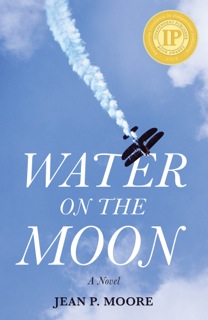
Guestpost: Water on the Moon by Jean P Moore


Water on the MoonI am happy to be part of TLC's tour for Water on the Moon by Jean P Moore.  Be sure to check out other tour hosts at the end of this post for reviews on this book.

Today I am sharing a guestpost by the author.

~~~~~~~~~~~~~~~~~~~~

When I began writing Water on the Moon, a novel about Lidia Raven, divorced mother of twin teenage daughters, I had no idea I would soon be engrossed in the history of Amelia Earhart. That’s the way it appears to be with novel writing—one thing leads to another unanticipated thing. For me, that is the thrill of writing. It is like setting out on an arduous climb, not sure what you may find over the next peak.

We first see Lidia on a leisurely morning, reading in bed, but soon she hears a sputtering airplane engine coming close, much too close. She jumps into action and miraculously saves her family, including their black Lab, Opal, when the plane crashes into their historic Connecticut farmhouse.

The main plot centers on the connection between Lidia and the pilot of the plane, Tina Calderara, who is killed on impact. Tina is an enigmatic and troubled character who is obsessed with the pioneers of aviation history, particularly Amelia Earhart. She loves her daring and her spirit, but unfortunately Tina shares nothing of Earhart’s true strength, her noble character.

What we know of Amelia Earhart (born July 24, 1897), her record-breaking flights and her tragic loss in 1937 as she was trying to circumnavigate the globe, are the most sensational features of her all too brief life. She was as well a supporter of woman’s rights who encouraged women to follow their dreams, whether in the air or on the ground. She was a champion of courage when confronting fears, accepting challenges, and facing the odds. A sampling of her words attests to these qualities:

In spurring women of her era on to greater achievements, she did not “sugarcoat” the dangers inherent in striking out on one’s own:
“Please know that I am aware of the hazards. I want to do it because I want to do it. Women must try to do things as men have tried. When they fail, their failure must be a challenge to others.”
In discussing the challenges in taking on difficult tasks, she zeroed in on the greatest threat, our own fears:
“The most difficult thing is the decision to act, the rest is merely tenacity. The fears are paper tigers. You can do anything you decide to do. You can act to change and control your life; and the procedure, the process is its own reward.”
And prophetically, perhaps, she knew that embarking on a perilous journey was only the beginning:
“In soloing - as in other activities - it is far easier to start something than it is to finish it.”
And putting all the fears, dangers, and obstacles aside, she got to the heart of it in this, her most famous quote:
“Never interrupt someone doing what you said couldn't be done.”
In my novel, the pilot, Tina, may have had the courage to follow her dreams and to become an accomplished aviator in her own right, but it is Lidia who must face her demons and find the courage to accomplish the tasks fate has handed her.

My hope in writing Water on the Moon was to create a “page-turner” that perhaps would also shine a light on the gifts left to us in the stories of such historical figures as Amelia Earhart. 

~~~~~~~~~~~~~~~~~~~~~~~~~

Paperback: 244 pages
Publisher: She Writes Press (June 3, 2014)

Acclaimed Debut Novel, Winner of the 2015 Independent Publishers Book Award for Contemporary Fiction
When her husband comes out as gay and an airplane crash inexplicably destroys her home, the mother of teenage twin daughters must rethink everything she knows.

In her debut novel Water on the Moon, Jean P. Moore introduces readers to Lidia Raven, whose life begins taking seemingly endless wrong turns. Lidia and her girls miraculously survive the plane crash that destroys their home and are taken in by Lidia’s friend Polly, a neighbor with a robust collection of first-edition books who lives alone on a sprawling estate.

Struggling to cope with each of these life-changing events, Lidia discovers a connection between herself and Tina Calderara, the pilot who crashed into her home. In the months that follow, Lidia plunges into a mystery that upends every aspect of her life.

Rife with age-old dilemmas, this contemporary novel explores the relationships between mothers and daughters and the trials and triumphs of women’s friendships. As Lidia learns to reconcile her pain with her need to be true to herself and to accept that need in others, she discovers that while life has the power to unhinge her, it also has the power to open her to new ways of being in the world.

Set off by the poetry of Lord Byron, Water on the Moon received the 2015 Independent Publishers (IPPY) Book Award for contemporary fiction. Book Awards Coordinator Amy Shamroe comments, “Water on the Moon starts with chaos, but the story that unfolds is a carefully layered mystery that allows for meaningful character development. With simple, clean prose, Jean Moore crosses generations to bring a feeling of connection to the seemingly random, tragic event at the heart of the book.”

A fusion of history, romance, and mystery, Moore’s ambitious debut dazzles. With sympathetic characters who come alive, and with threads of Byron and Earhart cleverly woven throughout the pages, Moore spins a bewitching tale of hope, tragedy, and family secrets.” ~ Lori Nelson Spielman, author of The Life List and Sweet Forgiveness

Add to Goodreads badgePurchase Links

Amazon | Books-A-Million | Barnes & Noble


Jean P. Moore, Water on the Moon copy copyJean P. Moore began her professional life as an English teacher, later becoming a telecommunications executive.  She and her husband, Steve, and Sly, their black Lab, divide their time between Greenwich, Connecticut and the Berkshires in Massachusetts, where Jean teaches yoga in the summers.

Her work has appeared in newspapers, magazines, and literary journals such as upstreetSN ReviewAdannaDistillery, Skirt, Long Island Woman, the Hartford Courant, Greenwich Time, and the Philadelphia Inquirer. Water on the Moon was published in June of 2014 and won the 2015 Independent Publishers Book Award for Contemporary Fiction.

Connect with Jean

Website | Blog | Twitter


Jean P. Moore’s TLC Book Tours TOUR STOPS:


Monday, October 19th: Bibliotica
Tuesday, October 20th: Books a la Mode – author guest post
Wednesday, October 21st: Mallory Heart Reviews
Thursday, October 22nd: Kritter’s Ramblings
Monday, October 26th: Patricia’s Wisdom
Tuesday, October 27th: Thoughts from an Evil Overlord
Wednesday, October 28th: Bookmark Lit
Thursday, October 29th: Mallory Heart Reviews – author guest post
Monday, November 2nd: 5 Minutes for Books
Tuesday, November 3rd: Just One More Chapter – author guest post
Wednesday, November 4th: A Bookish Way of Life
Friday, November 6th: Necromancy Never Pays
Monday, November 9th: Diary of a Stay at Home Mom
Tuesday, November 10th: Savvy Verse and Wit
Thursday, November 12th: Kahakai Kitchen